
The real growth problem
Most Contractors Do Not Need More Marketing.
They need the marketing they already pay for to stop leaking revenue.
Most established contractors already have a website. They run ads, pay for leads, answer calls, send estimates, complete jobs, and ask for reviews when someone remembers. Yet many owners still cannot answer one basic question: Where did our last ten booked jobs actually come from?
Not clicks. Not impressions. Not form fills. Booked work.
The problem is rarely a total lack of activity. It is that the activity is disconnected. One company manages the website. Another handles search. Paid leads arrive in separate inboxes. The office answers calls. Dispatch schedules jobs. Sales follows estimates. Technicians complete the work. Reviews and referrals happen inconsistently. Reporting stops before the job outcome.
Everyone may be doing their part. But no one owns what happens between the parts. That is where opportunity disappears.
A qualified call reaches voicemail. A form sits untouched. A lead is routed to the wrong person. An estimate loses momentum. A satisfied customer is never asked for a review or referral. A past customer is never contacted again. An ad campaign looks successful because it generated leads, even though few became profitable jobs.
The answer is not automatically more ads, more software, or another vendor. The answer is a connected growth system built around three outcomes: acquire more qualified opportunities, convert more of them into action, and compound the value of every customer.
When those outcomes work together, each one improves the next. When they operate separately, you keep paying to replace opportunities you already had.
The demand trap
More Leads Will Not Fix a Broken System.
Revenue slows down, so the company buys more leads. The schedule has openings, so ad spend increases. Sales misses a target, so another campaign launches.
But more demand poured into a weak system does not solve the problem. It magnifies it.
If calls are missed, more leads create more missed calls. If response is slow, more leads create a larger backlog. If qualification is weak, more leads waste more office and dispatch time. If estimates are not followed up, more leads create a bigger pile of forgotten opportunities. If outcomes are not tracked, more marketing creates more confusion.
It is like pouring water into a bucket with holes in the bottom. The agency celebrates how much water went in. The owner wonders why the bucket is still empty.
Before adding demand, identify the actual constraint. It might be visibility, lead quality, response, booking, estimate follow-up, capacity, customer retention, or reporting. Until you know which one is limiting the whole system, every new tactic is a guess. Guessing gets expensive.
The operating framework
The Three Outcomes Behind Contractor Growth.
Contractor growth becomes easier to understand when you stop looking at channels and start looking at outcomes.
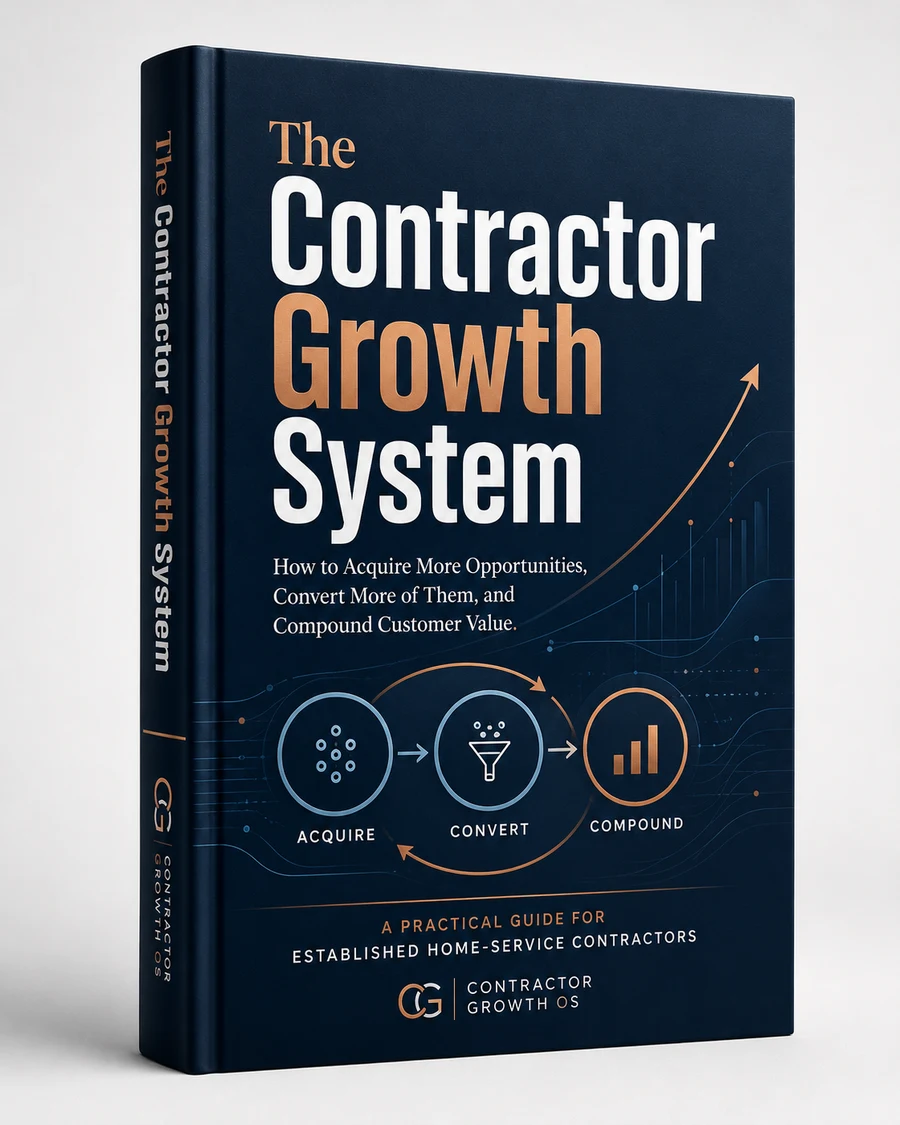
Acquire helps the right homeowners find, trust, and contact your company. Convert moves qualified opportunities toward the appropriate next step. Compound turns completed work and customer relationships into future growth.
These are not three separate departments. They form a loop. Better acquisition creates better opportunities. Better conversion creates more customers and clearer outcome data. More customers create reviews, referrals, repeat service, and stronger reputation. Those outcomes improve future acquisition.
The system becomes more valuable because each stage strengthens the next.
Create qualified visibility, trust, and demand.
Move qualified opportunities toward the appropriate action.
Turn customers and completed work into future value.
Outcome 01 / Acquire
Acquire More Qualified Opportunities.
Acquisition is often reduced to lead generation. That is too narrow.
Before a homeowner calls, they usually search, compare, read reviews, visit websites, check service areas, ask for recommendations, and decide which company feels credible enough to contact. Acquisition includes everything influencing that decision.
Your website, search visibility, Google Business Profile, listings, reviews, paid channels, content, social presence, referrals, and local familiarity all work together. The objective is not maximum attention. It is qualified attention from homeowners you can serve profitably.
Your Website Has a Job
A contractor website should do more than describe the company. It should move the right homeowner toward the right next step. That might mean calling, requesting service, booking an estimate, sending project details, or starting a conversation.
A beautiful website can still fail. It can look modern while making the homeowner work too hard. It can receive traffic while producing weak inquiries. It can rank while sending visitors into a form nobody follows up.
A strong website makes the service clear, establishes trust quickly, confirms location fit, creates an obvious next step, and captures useful context for the handoff. The website should function as the front door to the growth system, not a digital brochure.
Search Is Not One Tactic
Local visibility is influenced by the relationship between the website, Google Business Profile, listings, reviews, location relevance, service content, technical performance, structured data, local authority, and competition.
These signals affect the same buying decision. That is why search, Maps, listings, reputation, and website conversion should not be managed as unrelated projects.
You can rank and still fail to convert. You can have strong reviews and still show inaccurate information. You can have a good website and still be invisible in the markets you want. The parts have to support one another.
Paid Leads Must Be Measured Past the Lead
A cheap lead can be very expensive. One source may generate leads for $40 and another for $90. The first looks better until you discover most of those leads are outside your area, request the wrong service, do not answer, book poorly, or produce low-value jobs.
Meanwhile, the $90 leads may fit your target services, live in better locations, book at a higher rate, and become repeat customers. You cannot know which source is cheaper from cost per lead alone.
- What did it cost to create a qualified opportunity?
- What did it cost to create an appointment?
- What did it cost to create a booked job?
- What revenue and gross profit did that source produce?
Reputation Starts Before the Call
Reviews are often treated as something that happens after the job. But they influence the next customer before the next call.
A homeowner sees the rating, recent reviews, review volume, customer experiences, and how the company responds to problems. Reviews reduce uncertainty. Reduced uncertainty improves conversion.
Reputation belongs to both acquisition and customer growth. Completed work creates reputation. Reputation improves future acquisition. That is the compounding loop in action.
Outcome 02 / Convert
Convert More Opportunities.
Acquisition creates the opportunity. Conversion determines whether it goes anywhere. This is where contractors often lose revenue they already paid to create.
The ad worked. The homeowner called. The website did its job. Then the handoff broke. Nobody answered. The form went to an inbox. The callback came too late. The lead was routed to the wrong person. The homeowner repeated the same information three times. The estimate went out and disappeared.
The office assumed sales was following up. Sales assumed the office had it. The opportunity quietly died. Then the company bought another lead.
Fast Response Is Not Enough
Speed matters. But fast response without direction does not create much value. A quick message saying someone will get back to you is better than silence. It is not a conversion system.
A stronger system identifies what the customer needs, whether the location and service fit, how urgent the request is, who should own it, whether it can be booked, and whether a person needs to step in. The goal is not simply to answer. The goal is to move the opportunity toward a clear outcome.
Qualification Protects Revenue and Capacity
Good qualification does not make customers jump through hoops. It protects everyone’s time.
It can prevent the wrong technician from being dispatched, unsupported jobs from being booked, high-value opportunities from being buried, or the calendar from being filled with work the company does not want.
A no-heat call should not follow the same path as a remodeling inquiry. A maintenance request should not be handled like an emergency. Qualification should help determine service fit, location, urgency, customer type, timing, available capacity, and the right next step.
Automation Should Follow the Business
Many automation projects fail because the company buys a tool and then changes its process to fit the tool. That is backwards.
The company should define the services it offers, locations it serves, hours, appointment rules, pricing boundaries, emergency policies, escalation paths, quiet hours, consent requirements, and when a human must take over. The automation should apply those rules consistently. It should not invent them.
A Missed-Call Text Is Not a Missed-Call System
A missed-call text-back is useful. But it is only the first step.
A complete recovery workflow acknowledges the call, identifies the service, verifies the location, checks urgency, offers the appropriate next step, alerts the team when necessary, follows up, and records what happened. The value is not the text. The value is recovering the opportunity.
The Estimate Is Not the End of the Sale
A homeowner who says they need to think about it may still have questions, need financing, want to compare options, need to speak with a spouse, or simply need more time. Another company may follow up first.
A structured estimate follow-up process confirms receipt, answers questions, surfaces objections, restores momentum, escalates high-value opportunities, and records why work was won or lost.
This does not mean sending endless automated messages. It means making sure valuable opportunities receive appropriate attention.
Human Takeover Is a Feature
A strong system knows when a person belongs in the conversation. Human judgment may be required when safety is involved, pricing needs discretion, the customer is upset, a high-value opportunity deserves personal attention, an exception is needed, or the available information is incomplete.
The objective is not to remove people. It is to remove unnecessary delay, repetition, and confusion so people can focus where judgment matters.
Outcome 03 / Compound
Compound Customer Value.
Most contractors spend heavily to create a customer. Then they treat the completed job like the end of the relationship. The invoice is paid, the technician leaves, the record closes, and everyone moves on.
But that customer may be able to create a review, referral, membership, maintenance relationship, repeat service, future replacement, project story, or better lead-source data. None of that happens automatically just because the job went well.
A completed job is not only revenue. It is an asset. The Compound stage develops that asset.
Reviews Create Future Demand
A review can improve trust, reduce buying uncertainty, support local visibility, strengthen conversion, and reveal operational problems.
Reviews need to be requested consistently, at the right time, and in a compliant way. Review gating should be avoided. Negative feedback should reach the right person so the company can respond and protect the relationship.
Referrals Need a System
Many contractors say most of their work comes from referrals, then have no referral process. No defined timing. No standard request. No tracking. No follow-up.
That is not a referral system. It is referral hope. A real process defines who should be asked, when the request happens, how it is tracked, and what happens after the referral arrives.
Retention Creates Demand You Do Not Have to Repurchase
The customer who already knows you is often easier to reach than the homeowner who has never heard of you.
Maintenance reminders, membership renewals, seasonal service, warranty timing, equipment-age follow-up, repeat projects, and cross-service opportunities can create relevant reasons to reconnect.
The key word is relevant. A generic promotion sent to every contact is not customer intelligence. A stronger system uses available customer, property, equipment, timing, and service history to create the appropriate next message.
Your Database May Be Your Most Ignored Asset
Established contractors often have thousands of records: past customers, old estimates, dormant leads, lapsed members, incomplete follow-up, and aging equipment. Then every month they spend more money to acquire strangers.
Sometimes the next opportunity is already inside the business. Reactivation should identify relevant segments and create appropriate outreach based on service history, timing, permission, capacity, and customer value.
Customer Outcomes Improve Future Acquisition
When the company can connect lead source, conversation, qualification, appointment, estimate, job, revenue, review, referral, and repeat service, better decisions become possible.
Leadership can see which channels create good customers, which services convert, which locations perform, where handoffs break, which estimates stall, and where money is being wasted. The outcome of one customer improves the system used to acquire the next.
The operating loop
The Contractor Growth Loop.
Acquire creates qualified visibility, trust, and demand. Convert moves qualified opportunities toward the appropriate action. Compound turns customers and completed work into future value. Optimize uses outcome data to improve acquisition, conversion, and customer growth. Then the cycle repeats.
Better reviews improve search and conversion. Better conversion creates more customers. More customers create more reviews and referrals. Better outcome data improves channel decisions. Better decisions create stronger acquisition.
Every stage strengthens the next. That is what makes the whole system more valuable than the individual parts.
Qualified visibility, trust, and demand
Qualified opportunities reach a clear next action
Customers create reviews, referrals, and repeat value
Outcome data strengthens the next acquisition cycle
Constraint-first growth
Find the Constraint Before You Add More.
You do not need to install every possible system at once. You need to find the bottleneck limiting the result.
If people cannot find you, the constraint may be visibility. If you have open capacity but not enough opportunity, it may be demand. If leads arrive but few are a good fit, it may be targeting or qualification. If inquiries are not handled consistently, it may be response. If conversations happen but few become appointments, it may be booking.
If estimates are issued but stall, the constraint may be follow-up. If the schedule is already full, it may be capacity. If completed jobs create little future value, it may be retention, reviews, referrals, or reactivation. If no one can connect marketing to booked work, it may be reporting.
The wrong solution applied to the wrong constraint wastes money. The right solution applied to the real constraint can improve the value of everything around it.
More Demand Is Not Always Better
Suppose your technicians are fully booked, estimators are overwhelmed, the office is behind on callbacks, or the installation calendar is pushed out for weeks. Should you buy more leads? Maybe not.
The stronger move may be better qualification, better job selection, tighter service-area boundaries, stronger estimate follow-up, clearer scheduling communication, improved reviews, better retention, or off-peak demand planning.
Growth should match the operation’s ability to deliver. The goal is not the largest possible lead count. The goal is profitable demand your company can handle well.
Outcome intelligence
Measure What Helps You Decide.
Do not track everything because a dashboard can display it. Track what helps you make a better decision.
Reporting should not create another dashboard nobody uses. It should make the next decision more obvious.
- Which sources create qualified opportunities
- Which opportunities become appointments
- Which appointments become jobs
- What it costs to create booked work
- Why qualified opportunities are lost
- Which estimates need attention
- Which completed jobs create future value
- Where data is missing
- What part of the system should improve next
System architecture
The Six Connected Growth Systems.
The Acquire, Convert, and Compound framework can be supported by six connected systems.
These are not six unrelated products. They are six parts of the same customer-growth system. A contractor may begin with one or two based on the current constraint, then expand as the operation is ready.
The system should grow around the bottleneck, not around a predetermined package.
- WebOS supports the website and conversion foundation.
- SearchOS supports search, Maps, listings, local visibility, and AI-search readiness.
- LeadOS manages appropriate paid and marketplace demand.
- SocialOS builds familiarity, authority, and social opportunity.
- ConversionOS manages response, qualification, routing, booking, follow-up, and intelligence.
- RepOS supports reviews, referrals, retention, memberships, and reactivation.
Your Owned Conversion Hub
A mobile-first conversion hub that makes services, locations, credibility, and the next step unmistakably clear, with SEO/AEO foundations and an accurate website AI CSR.
Explore WebOS →02 / RepOSReviews, Referrals & Retention
Turns completed work into authentic reviews, feedback ownership, referrals, retention, reactivation, and future customer value.
Explore RepOS →03 / SearchOSIntent-Based Local Discovery
Connects Google Business Profile, Maps, listings, local relevance, reviews, service-area signals, and defensible AEO so high-intent homeowners can find accurate information.
Explore SearchOS →04 / SocialOSAttention-Based Social Discovery
Turns projects, expertise, local proof, comments, and messages into qualified conversations that can enter the pipeline.
Explore SocialOS →05 / ConversionOSLead Conversion & Opportunity Recovery
Captures missed calls and leads, responds after hours, qualifies, books, follows up, recovers estimates, reactivates dormant opportunities, and preserves human judgment.
Explore ConversionOS →06 / LeadOSControlled Demand Generation
Adds managed demand through appropriate paid channels only when capacity, response, follow-up, and conversion are ready to handle it.
Explore LeadOS →Accountable delivery
What Fully Managed Should Mean.
Done for you often means: We set it up. Good luck.
A fully managed system should mean the partner accepts responsibility for the agreed strategy, implementation, management, monitoring, reporting, and ongoing improvement.
That may include building websites and workflows, managing approved acquisition channels, configuring follow-up, monitoring outcomes, improving lead quality, and refining the system over time.
The contractor should remain in control of services, pricing, availability, service area, emergency policy, technical judgment, customer standards, exceptions, and fulfillment. The system handles infrastructure and repetition. The team handles judgment and service delivery.
Leadership checklist
The Questions Every Contractor Should Be Able to Answer.
If leadership cannot answer these questions, the company does not have a complete growth system yet. It has pieces.
- Can the right homeowners find us?
- Which sources create qualified opportunities?
- What happens after every call, form, text, or message?
- How quickly and consistently do we respond?
- How are leads qualified and routed?
- Who owns the next step?
- What happens when an opportunity does not book?
- Who follows the estimate?
- What happens after the job?
- Are reviews, referrals, and repeat-service opportunities being created consistently?
- Can we connect lead source to appointment, job, and customer value?
- Do we know what is breaking?
- Do we know what should improve next?
The goal
The Goal Is Not More Marketing.
You can buy more traffic, leads, software, automation, dashboards, and vendors and still have the same revenue problem. More pieces do not automatically create a better system.
The goal is connection. The right homeowners find you. Their inquiries receive the appropriate response. Qualified opportunities reach the right next step. Estimates receive consistent attention. Completed jobs create future value. Leadership can see what is working, what is breaking, and what should improve next.
That is the Contractor Growth System. Not more activity. Not more software. Not more disconnected tactics. A connected system for acquiring demand, converting opportunities, and compounding customer value.